Every marketer wants the same thing: ads that keep performing.
But in 2025, performance doesn’t drop because of your targeting.
It doesn’t drop because of your bidding.
And it definitely doesn’t drop because “the algorithm is bad”.
Most of the time, performance drops for one simple reason:
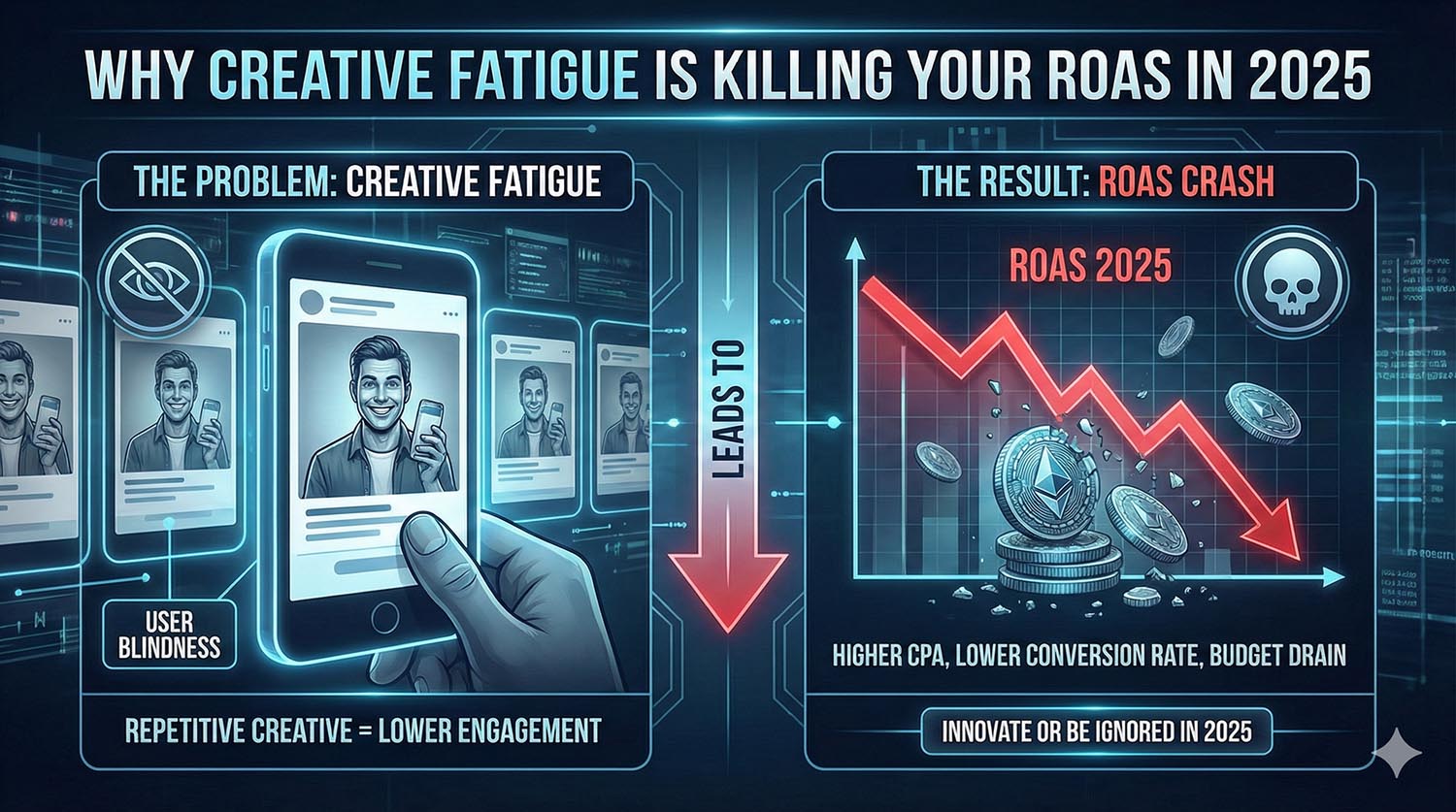
Your creatives are tired, and your audience is bored.
Creative fatigue has become the silent ROAS killer, and if you don’t fix it quickly, your best campaigns will slowly bleed money until they collapse. The frustrating part is that many businesses don’t even realize why their ads are failing. They keep changing audiences, tweaking budgets, switching bidding strategies — everything except the one thing that truly matters:
What people see.
Let’s break down why creative fatigue has become such a big problem in 2025, how to spot it early, and what smart brands are doing to stay ahead.
1. Why Creative Fatigue Happens Faster Than Ever in 2025
Five years ago, a good creative could run for months.
In 2025, you’re lucky if a creative performs for 2–3 weeks.
The reason is simple:
People consume more content than ever before.
- Short-form content exploded
- People scroll faster
- Attention spans are shorter
- Every platform pushes visual-first experiences
- Algorithms reward “freshness”
Your ad is no longer competing with other ads.
Your ad is competing with everything happening on a person’s screen — creators, memes, trending topics, viral videos, influencers, entertainment, and more.
When your creative becomes predictable, it becomes invisible.
That’s why creative fatigue hits faster now — not because your ad is bad, but because your audience has already seen something that looks like it 100 times today.
2. The Hidden Cost of Creative Fatigue That Most Brands Never Measure
When a creative gets tired, it doesn’t always crash dramatically.
Most of the time, the drop is subtle, slow, and easy to ignore.
Here’s what usually happens step by step:
- CTR decreases
- CPC increases
- CPM rises slightly
- Add-to-carts go down
- Leads become more expensive
- ROAS drops quietly
- The campaign looks “fine”… until it suddenly doesn’t
By the time you notice the drop, you’ve already wasted days or weeks of budget.
Creative fatigue drains your ROAS not in one big hit, but through constant small leaks.
It’s death by a thousand scrolls.
3. Why The Algorithm Punishes Repetitive Creatives
One thing marketers often forget:
The algorithm is built to maximize user happiness, not advertiser happiness.
If your ad triggers boredom, people scroll faster.
If people scroll faster, your ad loses quality score.
If quality score drops, your costs go up.
Platforms like Meta, TikTok and YouTube know exactly when your ad loses its power. They track:
- Time spent watching
- Scroll velocity
- Drop-off rate
- Engagement ratio
- Creative freshness
- Repetition intensity
When performance signals drop, the algorithm reduces your delivery or increases your cost.
Your budget doesn’t go as far anymore.
The platforms are literally telling you:
“Your creative is old. Give me something better.”
4. Signs Your Creative Is Fatigued (Before ROAS Actually Drops)
Good marketers don’t wait for revenue to decline.
They spot creative fatigue early.
Here are the earliest warning signs:
• Drop in 3-second or 1-second video views
This is usually the first sign. If fewer people are stopping in the first second, the hook is worn out.
• Your frequency hits 2.5 – 4 quickly
In 2025, frequency fatigue hits faster because audiences are smaller and content cycles are shorter.
• Lower engagement (likes, comments, shares)
People stop reacting because they’ve seen the message repeatedly.
• Your CPC climbs slowly over several days
This is the quiet, hidden killer. CPC creep almost always means the creative is getting weaker.
• Add-to-cart numbers dip without major targeting changes
This means the audience saw the ad but lost the excitement to act.
Spotting these signs early saves money and keeps performance stable.
5. The Biggest Reason Brands Struggle: Not Enough Creative Volume
Most brands don’t have a performance problem.
They have a creative production problem.
In 2025, the brands that scale fast are the ones producing:
- 5 to 10 fresh creatives every week
- Multiple hook variations
- Multiple formats
- Multiple UGC styles
- Multiple storytelling angles
And here’s the interesting part:
**Your goal is not to create perfect creatives.
Your goal is to create enough creatives.**
Volume beats perfection.
Testing beats guessing.
Variety beats repetition.
When you produce enough creative volume, the algorithm always has something fresh to work with.
Fatigue becomes almost impossible.
6. What Smart Marketers Do to Prevent Creative Fatigue
Here are the strategies top-performing brands use in 2025 to keep ROAS steady and avoid burnout:
A) They rotate hooks aggressively
You can keep the same core idea, but change the hook every week.
Examples:
- “Nobody talks about this problem…”
- “This is why your X isn’t working…”
- “I wish I knew this earlier…”
- “Most people make this mistake…”
- “If you want better results, start here…”
A new hook = a new angle = a fresh entry point.
B) They test multiple UGC creators
Not every face works for every audience.
One creator may convert 3x better than another.
Brands who scale use 5–10 creators, not one.
C) They repurpose winning ads into new formats
A winning static → turned into a motion graphic
A winning video → turned into 5 shorter cuts
A winning testimonial → turned into a carousel
Refresh the structure, reuse the core insight.
D) They build a monthly creative calendar
This keeps creativity proactive instead of reactive.
A strong calendar includes:
- Hooks to test
- Pain points to highlight
- UGC scripts
- Style variations
- Platform-specific concepts
You never run out of ideas, and your funnel never slows down.
7. The Real Secret: Creative Is Now the Biggest Lever in Performance Marketing
2025 has made one thing very clear:
**Creative is the new targeting.
Creative is the new optimization.
Creative is the new scaling strategy.**
You can’t depend on audiences anymore.
You can’t depend on hacks or tricks.
You can’t depend on one good ad.
Your entire performance engine depends on your ability to tell stories that feel fresh.
And you cannot keep telling the same story with the same creative expecting different results.
Final Thought
Creative fatigue doesn’t happen because your product is bad or your brand is weak.
It happens because your audience is human.
People get bored.
People crave novelty.
People want something fresh.
If you don’t give it to them, the algorithm will give that advantage to someone else.
The brands that win in 2025 are the ones that:
- Produce consistently
- Test aggressively
- Refresh quickly
- Adapt to trends
- Never rely on one creative for too long
Fix your creative fatigue, and your ROAS will rise automatically.