
When ads stop working, almost every business owner has the same instinct.
“Let’s increase the budget.”
It feels logical.
More money should mean more reach.
More reach should mean more leads.
More leads should mean more sales.
But in 2025, this thinking is one of the fastest ways to lose money.
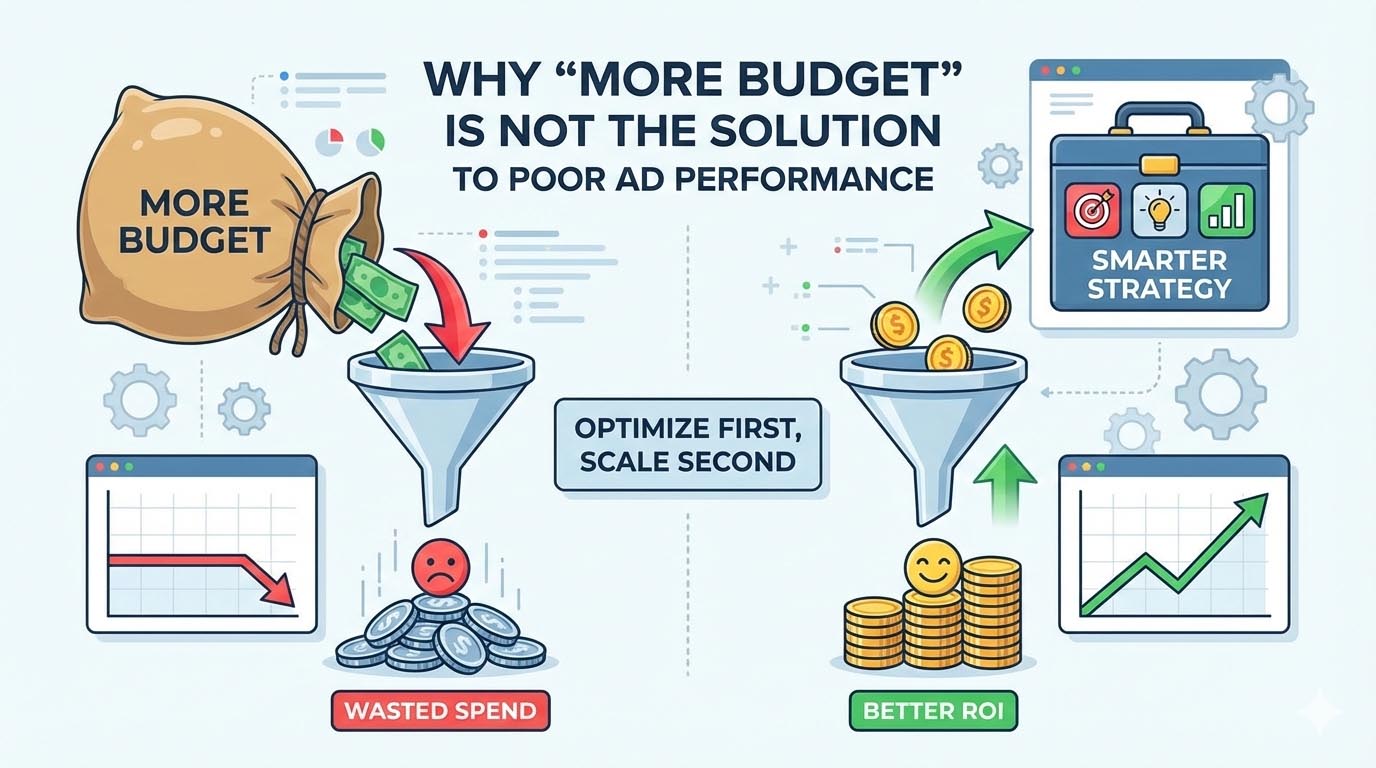
If your ads are underperforming, adding more budget rarely fixes the problem. In fact, most of the time, it makes the problem worse. Brands don’t fail because they don’t spend enough. They fail because they scale broken systems.
Let’s talk about why increasing budget feels like the right move, why it usually backfires, and what smart brands actually fix before scaling.
1. Why Increasing Budget Feels Like the Obvious Fix
When performance drops, pressure rises.
Sales slow down.
Leads feel weak.
Revenue targets feel far away.
At this point, increasing budget feels like action. It feels proactive. It feels like you’re “doing something” instead of sitting idle. Many agencies even recommend it, saying things like:
- “The algorithm needs more data”
- “Let’s push spend to exit the learning phase”
- “Scale first, optimize later”
Sometimes, these statements are true. But only when the foundation is already strong.
Most of the time, the foundation is not.
And that’s where the trouble starts.
2. Budget Does Not Fix Problems. It Amplifies Them
This is the most important concept to understand.
Budget is not a solution. Budget is a multiplier.
If your funnel is weak, more budget means more wasted traffic.
If your creatives are tired, more budget means faster fatigue.
If your landing page doesn’t convert, more budget means more drop-offs.
If your targeting is off, more budget means more irrelevant clicks.
In other words, budget doesn’t hide problems. It exposes them.
That’s why many brands see this pattern:
- Ads perform okay at low spend
- Budget is increased
- CPL jumps
- ROAS drops
- Performance becomes unstable
The system was never ready to scale. The extra money just made the cracks visible.
3. What Actually Breaks When You Scale Too Early
Scaling is stressful for ad systems.
When you increase budget, platforms like Meta and Google are forced to:
- Expand audience reach
- Show ads to new users
- Test new placements
- Re-evaluate performance signals
If your inputs are weak, the algorithm has nothing good to work with.
Here’s what usually breaks first:
Creatives burn out faster
Your best-performing creative suddenly gets shown more frequently. Frequency increases. Engagement drops. Performance slides.
Traffic quality declines
To spend more money, platforms move beyond your core audience. Clicks still come, but intent drops.
Conversion rates fall
Landing pages that were barely converting at lower volume now collapse under higher traffic.
Sales teams feel the impact
Leads increase in number but decrease in quality. Follow-ups become harder. Trust drops.
And then everyone blames the platform.
4. Signs That You Are Not Ready to Increase Budget
Before adding even one extra rupee to your ad spend, you should be able to answer “yes” to most of these questions:
- Are my ads converting consistently at the current budget?
- Do I have multiple creatives performing well, not just one?
- Is my cost per result stable for at least 10–14 days?
- Does my landing page convert reliably on mobile?
- Am I getting leads or customers that actually convert to revenue?
- Do I understand where users drop off in the funnel?
If the answer is “no” to most of these, scaling is not the next step. Fixing the system is.
5. The Real Reasons Ads Underperform (And Budget Can’t Fix Them)
Let’s look at the most common root causes of poor performance in 2025.
Weak creatives
Creative quality is the biggest lever in performance marketing today. If your ads don’t stop the scroll, no amount of budget will save them.
Mismatched messaging
Your ad promises one thing. Your landing page delivers another. Users feel confused and leave.
Low trust
No reviews. No proof. No credibility. Users hesitate and abandon.
Poor mobile experience
Most clicks come from mobile. Most conversion issues also happen on mobile.
Wrong expectations
Your ads attract curiosity, not buyers. Clicks go up. Conversions don’t.
None of these problems are solved by spending more.
6. What Smart Brands Fix Before Scaling
Brands that scale profitably in 2025 follow a very different approach. They treat budget increases as the final step, not the first one.
Here’s what they focus on first:
A) Creative volume and freshness
They don’t rely on one winning ad. They continuously test new hooks, formats, creators and angles.
If one creative slows down, another is ready.
B) Message clarity
The ad, the landing page and the offer tell the same story. No surprises. No confusion.
C) Conversion rate optimization
Even small improvements in conversion rate make scaling easier. A page that converts at 2 percent is far easier to scale than one converting at 0.7 percent.
D) Lead or customer quality
They track what happens after the form fill or purchase. Revenue matters more than vanity metrics.
E) Retention and follow-up
They don’t depend on first-click conversions. Remarketing, email, WhatsApp and nurturing are part of the system.
Once these pieces are stable, scaling becomes logical instead of risky.
7. How Budget Should Actually Be Increased in 2025
When you are ready to scale, budget increases should be:
- Gradual, not aggressive
- Data-backed, not emotional
- Tied to performance stability
Smart scaling looks like:
- Increasing budget by 10–20 percent at a time
- Monitoring results for a few days
- Scaling winning campaigns, not everything
- Letting creatives lead the scale
This approach protects ROAS and keeps the algorithm stable.
8. The Biggest Mindset Shift Business Owners Need
The biggest mistake is thinking of ads as a spending problem.
Ads are not about how much money you put in.
They are about how well the system is built.
A strong system can scale with confidence.
A weak system collapses under pressure.
Once you accept this, your decisions change. You stop chasing quick fixes and start building foundations.
Final Thought
More budget is not the enemy.
But it is never the starting point.
If ads are underperforming, your job is not to spend more. Your job is to understand why the system is leaking and fix it.
When the system works, scaling feels easy.
When it doesn’t, budget only accelerates failure.
In 2025, the brands that win are not the ones who spend the most.
They are the ones who scale at the right time, for the right reasons.